
Some roads seem to know us before we ever turn onto them.
They don’t show off. They don’t need neon signs, tourist crowds, or a line of folks waiting to take the same photograph. They just roll quietly across the Oklahoma countryside, past wheat fields, leaning fence posts, old storefronts, and places with stories still tucked into the cracks.
That’s the kind of road Peep and I seem to find over and over again.

Or maybe it finds us.
Peep was in town helping me through one of the roughest stretches of my life. Over the past two months, serious health complications put me in two different hospitals, including time in a medical coma, along with radiation treatments for cancer in my lungs. These days, I’m tethered to oxygen twenty-four hours a day, seven days a week.
That changes just about everything.
Even a simple outing takes planning. There are oxygen tanks to count, regulators to check, breathing treatments to work around, prescriptions to keep straight, and a large oxygen concentrator that has become part of daily life whether I like it or not.
Peep came in mainly to help get me to medical appointments, watch over me during the day, and keep an eye on the prescription routine and breathing treatments. That is not exactly the glamorous side of travel photography, but it is the real side of this story.
And still, if you know us, you know it is hard to keep either one of us out of the travel.
So we did what we do. We wrangled enough oxygen tanks, checked what needed checking, packed what needed packing, and carved out about four hours away from the house. Not a grand expedition. Not a long-haul adventure across several states. Just a little run west of the Oklahoma City metro, toward Binger and the quieter parts of the map.
After two months of hospitals, oxygen lines, pill bottles, treatments, and waiting rooms, even a backroad drive felt like freedom. The camera in my hand felt familiar. The conversation with Peep felt familiar. The Oklahoma wind felt familiar. For a little while, the road reminded me there is still beauty waiting beyond the hard days.
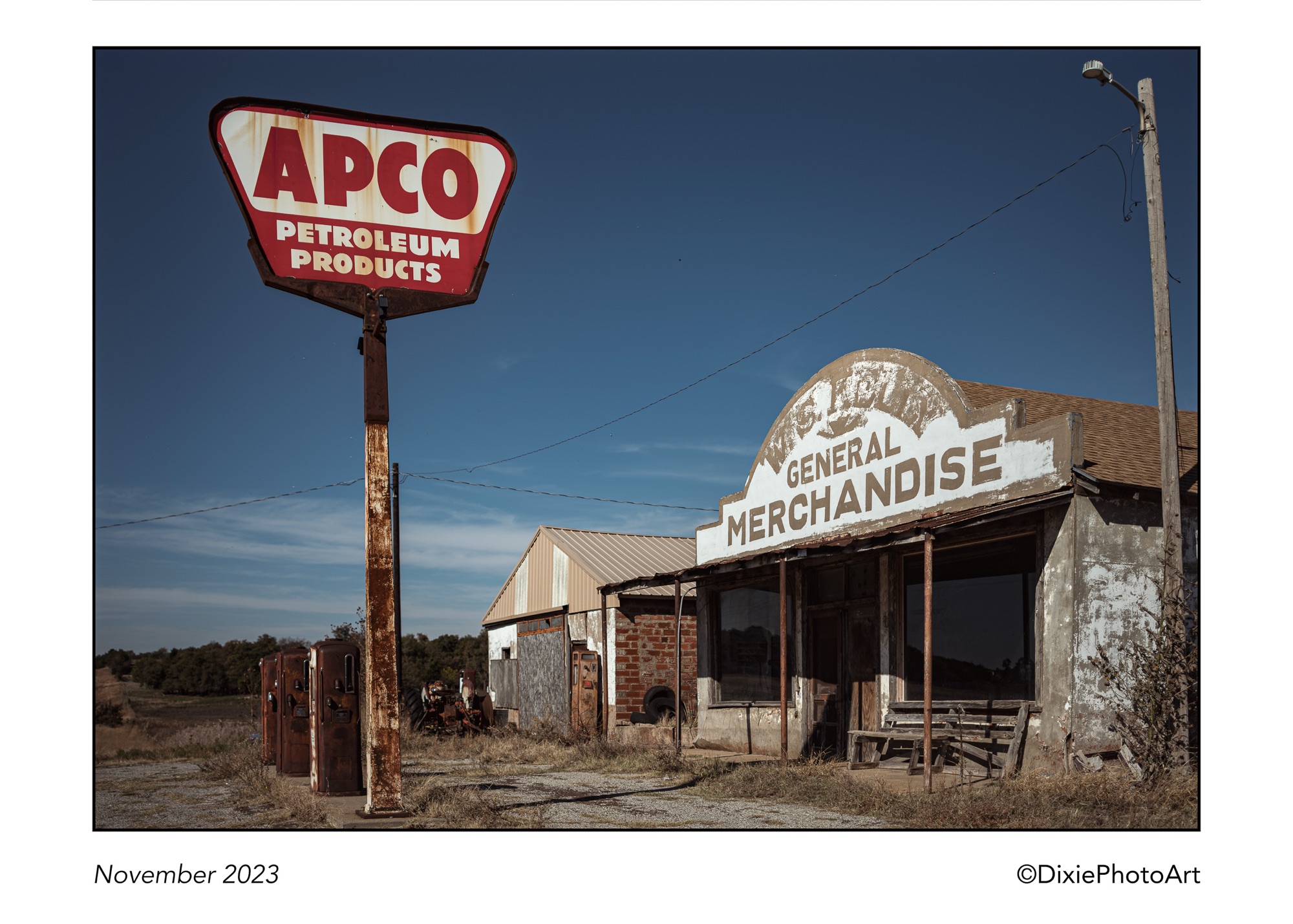
On that drive, we passed through Cogar, Oklahoma, and stopped at the old APCO station made famous by the movie Rain Man. It is one of those places that has always felt like more than a movie location to me. Sure, there is the Hollywood connection. Dustin Hoffman. Tom Cruise. A little Oklahoma crossroads that found its way into film history.
But standing there in person, it feels like something more honest than a movie set.
It feels like a survivor.
It feels like a family place. A rural landmark that once had life moving through it every day. Work boots across the floor. Somebody buying gas. Somebody asking directions. A cold drink from the cooler. Local talk at the counter. A kid hanging around out back, never knowing strangers might one day come looking for this place because a piece of movie history passed through town.
Peep and I had been there before, back in November of 2023, on another adventure heading toward Kansas and Nebraska. We spent time with the place then. We didn’t rush it. We didn’t just grab a trophy shot and leave. We looked, listened, photographed, and let the old station speak in its own dry Oklahoma way.
This time felt different.
The big APCO sign was gone.
I remembered reading the news story about it being stolen, though the exact date was fuzzy in my head. Standing there now, seeing that empty frame where the sign once held court, it hit harder than I expected.
The windows were boarded. The place looked more wounded than weathered, more vandalized than forgotten.
And there is a difference.
Forgotten places carry age. They carry dust, rust, peeling paint, and silence. They can look tired, but there is still dignity in them. Vandalized places carry something else. They carry the sharp edge of people taking without caring, breaking without listening, removing pieces of a story because they see an object and not a memory.
Peep and I grabbed a few shots, but we both knew we weren’t just photographing an old gas station. We were photographing a warning.
This happens everywhere. All across the country, on back roads and forgotten main streets, the pieces keep disappearing. Old signs vanish. Windows get busted. Buildings get stripped. Murals fade. Small-town landmarks become targets for collectors, vandals, weather, neglect, or plain indifference.
And once they are gone, they are gone.
That is part of why Forgotten Main Street matters so much to us. It has never been just about old buildings or ruins for the sake of ruins. It is about presence. It is about honoring the places most folks pass by at highway speed. It is about slowing down long enough to ask, “What happened here?” and “Who loved this place?” and “What story is still worth carrying forward?”
Because there is always a story.
Sometimes it is written on a sign. Sometimes it is hiding behind a boarded window. Sometimes it is in a family memory, a movie scene, an old business, a hand-painted wall, or the way afternoon light falls across a cracked doorway.
And sometimes the story is in two old friends, one of them counting oxygen tanks, both of them still stubborn enough to chase light down a two-lane road.
As we drove away from Cogar, something sparked between us.
We kept thinking about our visit in 2023. Back then, the station still had that old APCO sign standing proud. The place was weathered, yes, but there was still a kind of completeness to it. We had made images while that piece of the story was still there.
So we decided to share them.
Not only online. Not buried in a social media feed for half a second before the world scrolled past. We wanted to leave something physical behind. Something small. Something kind. Something that said, “This place mattered enough for somebody to notice.”
I printed a few 5×7 art cards from the photographs we made in 2023. I placed them in clear ziplock bags with Forgotten Main Street business cards and stickers. Nothing fancy. Nothing complicated. Just a little packet of art and story, protected from the Oklahoma wind and dust as best as I could manage.

Take. Share. Follow.
But most of all, enjoy the place and all the stories.
That was the heart of it.
We weren’t trying to claim the place or make ourselves part of the landmark. We were simply leaving a small offering for whoever might come along next. Maybe a film fan. Maybe a road tripper. Maybe a photographer. Maybe somebody who grew up nearby. Maybe somebody who never knew what the station used to look like until they found that little print waiting there.
I like the thought of a stranger pulling up, seeing the empty frame where the sign used to be, then finding an art card showing that same place before another piece disappeared. Maybe the photograph helps them pause a little longer. Look a little closer. Feel something more than “old building” or “movie location.”
That is preservation too.
It does not always come with grants, committees, official markers, ribbon cuttings, or restoration crews. Sometimes preservation is a photograph. Sometimes it is a story told over coffee. Sometimes it is a print left behind in a plastic bag on a windy day in Caddo County.
Sometimes it is simply refusing to let a place disappear quietly.
The path less taken has history. It has names, families, storefronts, gas pumps, schoolhouses, churches, theaters, motels, diners, hand-painted signs, and crossroads that still matter even if the traffic moved elsewhere.
We can’t save everything. Lord knows, Peep and I have seen enough to know that.
But we can notice. We can document. We can speak kindly of these places. We can tell the stories. We can leave behind something better than broken glass.
That old APCO station in Cogar is not just a movie location. It is not just a missing sign. It is not just another stop on a backroad loop west of the metro.
It is a reminder that history is not always locked behind museum glass. Sometimes it is standing beside a quiet road, sunburned and fragile, waiting for someone to care before the next piece vanishes.
For me, this little outing was about more than photographs. It was about breathing room, in every possible meaning of that phrase. It was about friendship. It was about still being able to go. It was about Peep and me doing what we have always done, even if the logistics are harder and the road has a few more obstacles these days.
The stories are still out there.
The road is still calling.
And some of the most important history we have left is waiting quietly on the path most folks forgot to take.


Leave a Reply