

There are vehicles you own… and then there are vehicles that quietly become part of the story you’re chasing.
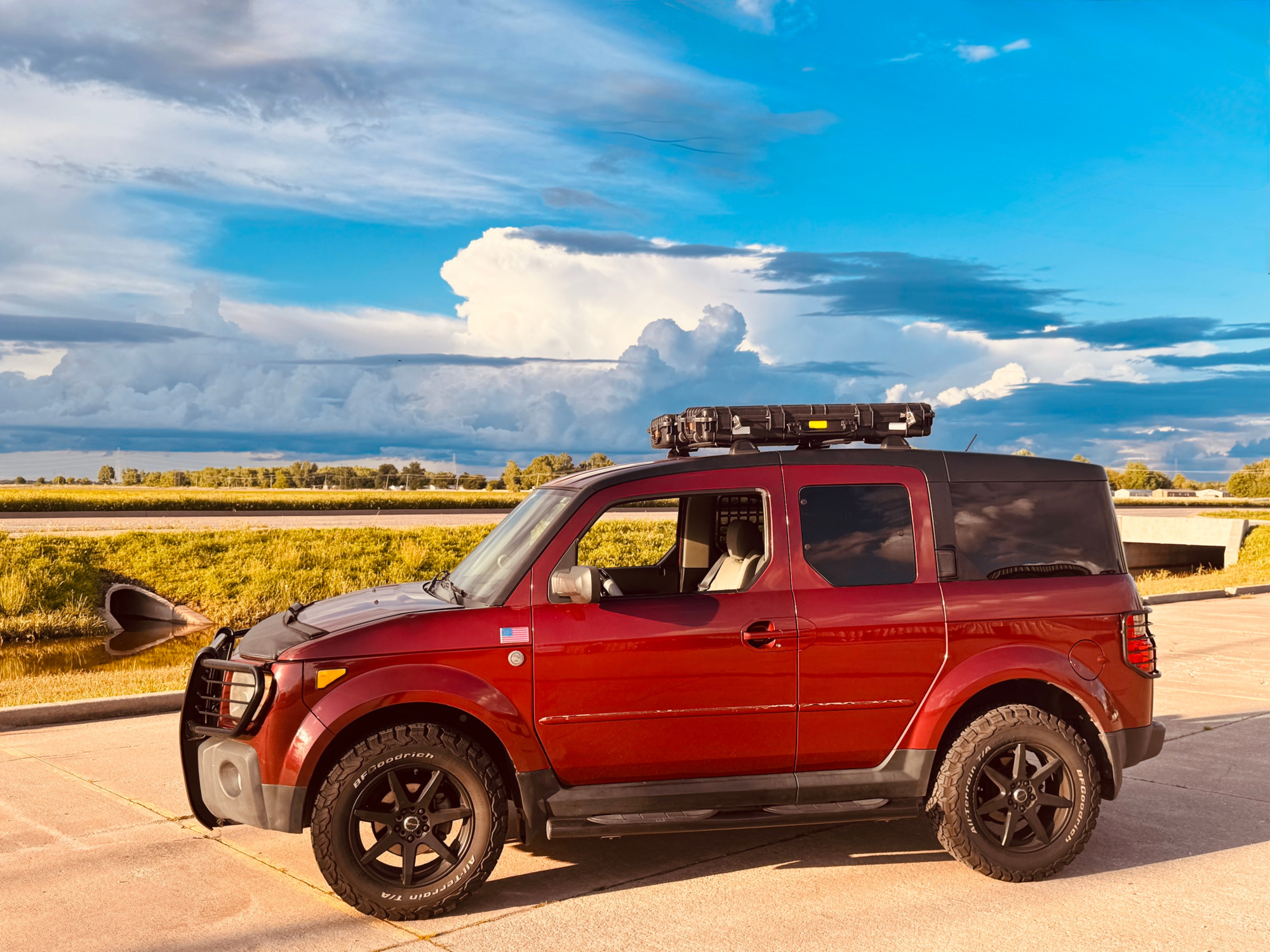
In January 2025, I picked up a 2007 Honda Element EX from Peep, and it didn’t feel like buying a used car so much as inheriting a rig that already knew what kind of life it was meant to live. This wasn’t a stock grocery-getter with a “maybe someday” dream of dirt roads. Peep had already put in the time—real upgrades, made with intention—so the Element was ready for Forgotten Main Street miles the moment the keys changed hands.

At first, the Element had a practical placeholder name: P2. It sounded like a file name. A project label. Something you type into a spreadsheet.
That name didn’t survive the first wave of curious strangers. You know the moment—someone at a gas station looks at the lift, the stance, the gear, and asks, “What do you call it?” I’ve had a long-time crush on Elvira, Mistress of Darkness, and it didn’t take long for the Element to earn a better identity. So P2 quickly became Elvira — Road Mistress, and I swear the name alone causes smiles. It’s hard to say it out loud without people grinning like they’ve just been let in on a private joke.
Peep built Elvira with real-world use in mind: the kind of roads that start out paved and end in gravel, the kind of routes that don’t show up as “recommended,” the kind of turns that happen because curiosity is louder than caution. He started with the fundamentals—capability and clearance—giving her a 2-inch lift and then going all-in on the stance with the largest tire setup that would fit. And he didn’t stop at “bigger rubber” as a vague idea. He upgraded the wheels too, pairing Raceline Tuning wheels with BFGoodrich All-Terrain T/A tires (LT245/65R17). The result is a rig that feels planted and confident, like it expects the road to get worse and isn’t bothered when it does.

From there, he added the kind of functional upgrades that don’t just look tough—they work tough. Inside, steel MOLLE panels created a cleaner way to mount and secure gear. Up front, large amber fog lights turned night driving and bad-weather visibility into something more trustworthy. A sturdy brushguard added protection for those backroad surprises—branches, debris, whatever the road decides to throw at you. He even added gas hood shocks, which sounds like a small thing until you’re doing maintenance and realize you’re no longer juggling that old prop rod while trying to see what you’re doing. It’s one of those “why didn’t this come this way?” improvements. And in the back, rock grids over the tail lights gave extra protection where gravel roads love to leave their signatures.

Then there’s the upgrade that quietly changes the entire experience of traveling: the Hot Rod Hero swivel seat base on the driver’s side. It turns the Element into a little command center. Park somewhere quiet, swing the seat, and suddenly you’re not just sitting in a car—you’re in a mobile basecamp. Planning routes, sorting gear, grabbing a quick meal, adjusting camera settings, checking maps… it all feels easier when the vehicle is built to support the way you actually travel.

When I took over, my focus shifted to the unglamorous side of adventure: reliability. Because once you’re deep into the least-seen places, the worst feeling isn’t getting lost. It’s realizing your rig has become the problem.
So I started tightening up the foundation. I replaced the front struts, torsion links, and springs, and went through the braking system—all brakes, plus the little pieces that matter more than anyone wants to admit, like caliper bolts and the miscellaneous hardware that can turn a simple job into a long day. I flushed and replaced fluids—engine oil, cooling system, transmission, transfer case—because I wanted a clean baseline I could trust.
I also went after the engine’s long-term health the right way: the valve adjustment was handled by David Joyce at ToasterParts.com, which falls into the category of “do it properly now so you don’t pay for it later.” ToasterParts is a one-stop hub for the Honda Element world: an online shop stocked with lots of Element-specific parts (including hard-to-find/collector items, manuals, and interior/exterior pieces) plus branded merch and community goodies. He also runs a real service operation out of Wilmington and offers mobile service requests, with common Element work like valve adjustments, brakes, VTEC harness upgrades, suspension (they note certification/install experience with HRG Offroad/Flatout), interior modernizations (CarPlay/Android Auto), and swivel-seat installs (certified Hiro’s Hotrods installer). Beyond selling stuff, the site leans into real community support: a “service providers & mechanics” map for when you’re stranded or need help on the road, a community marketplace for build inspiration and vetted listings, and a detailed, regularly updated Element build list (“Elephonte”) that shares what works (and what doesn’t).

But the best “small fix, huge impact” lesson so far has been the VTEC system. I replaced the VTEC solenoid several times chasing an issue that kept coming back—especially after wet conditions. It was the kind of problem that makes you question your life choices: a little water, a little bad luck, and suddenly you’re staring down the dreaded limp modewhen you’re trying to be miles away from the main road.
The real solution wasn’t another solenoid. It was the connectors.
Once I swapped out the connectors with the UPGRADED VTEC PIG TAIL from ElementDiy.com, the issue stopped haunting me. Now I can roll through water obstacles without that immediate “uh oh” moment and without getting kicked into limp mode. Thumbs up for reliability. That’s the kind of fix that pays you back every single mile.
Because FMS trips are as much about workflow as they are about wheels, I leaned hard into electrical stability and mounting. The stock 51R battery (500 CCA) got replaced with a larger 24F battery rated at 725 CCA, mounted on a stainless steel battery tray. The payoff is simple: better cold-weather starts, more stable power for electronics, and more headroom for future electrical load without flirting with a dead battery at the worst possible moment. I added multiple USB charging ports on the driver’s side, each supported by dedicated stepdown transformers so charging stays stable and clean—because nothing kills momentum like devices dying when you need them most.
For navigation, capture, and communication, I swapped the center console bezel to an older Element model with thicker plastic, then mounted a Bulletpoint RubiGrid system to support the gear that lives up front: an iPad mini for navigation, a DJI Osmo Pocket for quick video capture, and a handheld radio for when you’d rather communicate than guess.

One of the biggest quality-of-life changes, though, is something you don’t notice until you really need it: I replaced the rear-view mirror with a custom always-on rear camera system. That means even when the interior is packed with gear, I can still “see” behind me like the back window is clear. Anyone who’s ever loaded a rig for a long trip knows how priceless that is.
Lighting got attention also. I swapped the turn signals, brake lights, and all interior lights to high-output LEDs—brighter, faster, more practical. And while the fog lights are already dialed thanks to Peep, the front headlights are next: the assemblies are fogged, stealing output, so they’ll be replaced along with upgraded bulbs. Backroads at night don’t forgive “good enough.”

Somewhere in the middle of all this, I stumbled into a thought that hit harder than I expected: I wish I’d known about the Honda Element platform sooner. If I had, I probably would’ve bought one brand new and kept it forever. There’s a reason these rigs have such a loyal following—and why so many are still rolling strong past 200,000 miles, a number that would end the relationship for a lot of other vehicles. Honda was way ahead of its time with this adventure-ready, dog-friendly, almost-cargo-van versatile machine. Even years after production ended, the Element still has a thriving support community, meetups, and a full-on cottage industry of upgrades and accessories. It’s not just a car. It’s a tool. A cult classic that refuses to disappear.
And Elvira — Road Mistress is still evolving.
There’s a lot left on the upgrade roadmap for future FMS adventures and overlanding-style camping. The interior build is the next big chapter: a better desktop/workflow setup, smarter storage, and a real sleeping arrangement for trips where dawn light matters more than a hotel bed. The goal is to make the Element not just a way to get to the story, but a comfortable way to stay with the story.
One practical issue is already on the list: the spare. With the upgraded wheels and larger tires, the factory donut is basically a punchline. A mismatched spare on AWD isn’t just inconvenient—it’s risky, and I’ve read enough warnings to take it seriously. The plan is to build or buy a proper swing-out carrier so Elvira carries a real full-size spare that matches the setup, because the best kind of problem is the one you never have.
And then there’s the trips themselves—the real reason any of this matters.
One of my favorite recent runs was the Honobia trip in October 2025, when I went out with Dennis—my father-in-law—to explore the backroads and hunt for Bigfoot in the Kiamichi Mountains of southeast Oklahoma. It was exactly the kind of trip the Element was born for: quiet roads, wild edges, and that feeling that something interesting might be just around the next bend.
Want a peek at what these backroads actually look like? If you’d like to see images from the Honobia trip (October 2025)—where Dennis and I went hunting for Bigfoot in the Kiamichi Mountains of southeast Oklahoma—here’s the Flickr album: https://www.flickr.com/photos/trawickimages/sets/72177720329445236/
Now we’re lining up the next chapter. The plan for the next FMS run is for Peep to fly in from Bellingham, Washington, landing somewhere in Oklahoma or Kansas, and from there we’ll do what we do best: hit the backroads, stay off the main roads, and chase the least-seen corners of the map—the places that time stepped around, the towns that got quieter, the foundations and relics that still whisper if you slow down enough to listen.
But here’s the thing I don’t want to lose in all the talk about upgrades and gear: while Elvira is quickly becoming my ideal adventure rig for exploration, the truth is whatever you have that can get you where you need to be is already perfect.

The real win isn’t the vehicle. It’s the miles you choose. It’s the moments you notice. It’s the memories you bring back and share with other people.
Your story is unique. It’s important. And it’s meant to be captured.
So don’t get wrapped up in the things you don’t have, or the things you think you need. Ask the question that actually unlocks momentum:
“What can I do with what I have?”
Because less is often more freedom. And “so much more” has a funny way of becoming a burden—on your mind, your passion, and your pocketbook. Get out there. Use what you’ve got. Chase the backroads anyway.


Leave a Reply